When to Choose Gearbox‑Operated Gate Valve Instead of Standard Handwheel Gate Valve?
During gate valve selection, many buyers face this question: both are manually‑operated, why do some gate valves use standard handwheels while large‑size units require gearbox assemblies?
In fact, the gearbox‑operated gate valve is not a simple replacement for standard handwheel gate valves. The core difference lies in actuation methods. The final choice depends on real‑world service conditions: valve size, pressure, differential pressure, operating torque and on‑site access conditions.
Do not make decisions based merely on nominal diameter or nominal pressure. The correct approach is to check actual operating torque and verify whether manual force is sufficient for valve operation.
How Does a Standard Handwheel Gate Valve Work?
A standard handwheel gate valve drives the stem directly via handwheel rotation. Operators turn the handwheel to move the stem and gate disc up and down, to open or close the pipeline.
With simple structure and fewer transmission parts, this design is widely adopted for small‑to‑medium sized gate valves.
Suitable Scenarios for Standard Handwheel Gate Valves
- Low valve operating torque
- Sufficient on‑site space for direct manual operation
- Infrequent open‑close cycles
- Preference for simple structure and low‑maintenance requirements
For example, a medium‑small gate valve for general water service with low working pressure, low differential pressure across the valve, and accessible handwheel, will normally work well with standard handwheel actuation.
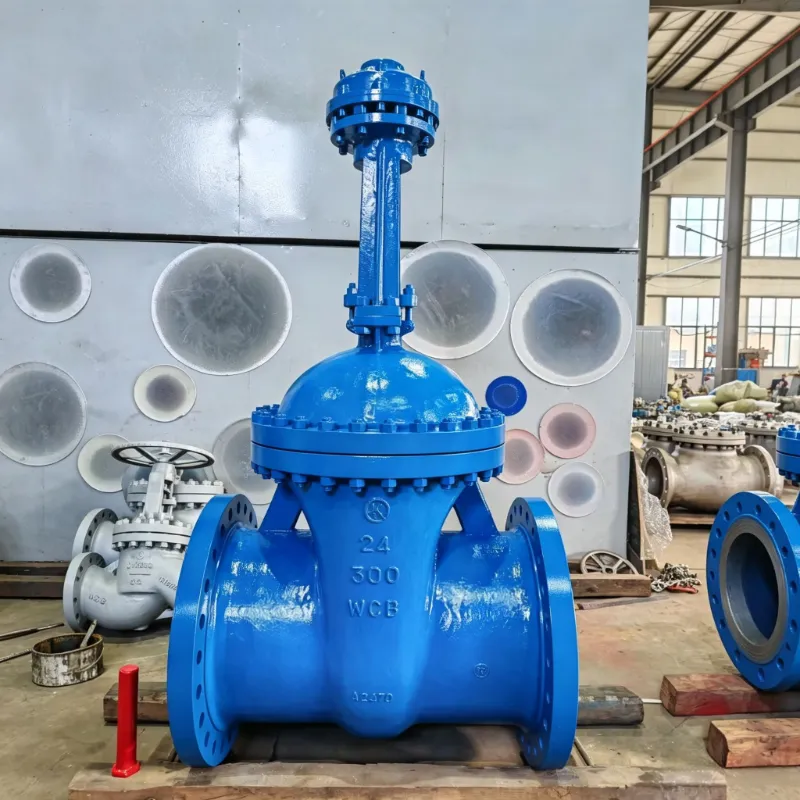
What Is the Function of Gearbox‑Operated Gate Valve?
A gearbox‑operated gate valve installs a mechanical gear transmission between handwheel and valve stem. Gear reduction boosts output torque, so operators can open or close the valve with much less manual force.
Please note: the gearbox will not change internal pipeline pressure, nor reduce medium pressure. It only solves the problem of insufficient manual operating force.
Key Problems Solved by Gearbox Actuation
- Reduce manual force required for valve operation
- Support valves with high breakaway torque demand
- Fit for large‑size and high‑load working conditions
- Suitable for installation locations with limited operating space
How Do Pressure and Differential Pressure Affect Gate Valve Operation?
Many sources simply state “high‑pressure valves need gearboxes”, which is not fully accurate.
One critical factor for valve opening difficulty is differential pressure — the pressure difference between upstream and downstream sides of the valve.
For instance:
| Scenario | Upstream Pressure | Downstream Pressure | Differential Pressure |
|---|---|---|---|
| A | 10 bar | 10 bar | 0 bar |
| B | 10 bar | 2 bar | 8 bar |
Even though both scenarios share 10 bar upstream pressure, Scenario B carries an 8 bar differential pressure. Much higher force is required to lift the gate disc.
The basic physical relationship can be summarized as:
Force = Pressure × Area
Given fixed pressure‑bearing area, higher differential pressure generates larger acting force.
Nevertheless, actual operating torque cannot be calculated from pressure alone. It is also affected by valve dimension, gate disc design, stem construction, sealing configuration and friction loss.
Why Cannot We Select Gearbox Solely Based on Valve Size?
In engineering practice, a common misconception exists:
“The larger the DN size, the more necessary a gearbox becomes.”
This conclusion is misleading.
Take DN300 gate valve as an example:
- One DN300 unit installed in low‑pressure water system with low differential pressure may still work with standard handwheel.
- Another DN300 unit for heavy‑duty industrial pipeline with high differential pressure during opening will require gearbox assistance.
Therefore, nominal size is only a reference index. Actual operating torque is the decisive factor for actuation selection.
Key Parameters to Check When Specifying Gearbox‑Operated Gate Valves
For large‑size or critical industrial applications, request the following data from your valve manufacturer:
| Parameter | Description |
|---|---|
| Operating Torque | The torque required during normal valve operation |
| Breakaway Torque | The initial torque required to start valve movement |
| Seating Torque | The torque required when closing the valve completely |
| Pressure Rating | The designed pressure class of the valve |
| Differential Pressure | The pressure difference across the valve during operation |
Breakaway Torque is particularly important. Valves staying closed for long periods often need extra torque to overcome static resistance at the moment of opening.
When to Use Standard Handwheel Gate Valves?
Standard handwheel gate valves are preferred for:
- Small‑to‑medium nominal sizes
- Low operation frequency
- Easy physical access for operators
- Operating torque within acceptable manual range
- Applications requiring simple structure and convenient maintenance
When to Use Gearbox‑Operated Gate Valves?
Gearbox‑operated gate valves are recommended for:
- Large‑size industrial gate valves
- Working conditions demanding high breakaway torque
- Valves installed in hard‑to‑reach positions
- Cases where direct manual operation becomes difficult
- Systems requiring stable mechanical actuation assistance
Gearbox‑Operated Gate Valve VS Handwheel Gate Valve: How to Decide?
When choosing actuation type, do not only focus on “what is the valve size” or “what is the nominal pressure”. Evaluate all items below comprehensively:
- Actual working pressure
- Differential pressure across valve body
- Valve nominal size
- Required operating torque
- On‑site installation conditions
- Operator access and operation mode
If a standard handwheel satisfies operation requirements, adding a gearbox brings no extra value. When manual operation becomes strenuous and high torque is demanded, gearbox actuation is the reasonable solution.
Conclusion
There is no absolute winner between standard handwheel gate valve and gearbox‑operated gate valve.
Handwheel solutions feature simple construction for favorable operating environments. Gearboxes reduce manual workload via mechanical transmission, ideal for large‑size, high‑load or hard‑access installations.
The correct selection workflow should follow:
Service Conditions → Differential Pressure → Operating Torque → Actuator Type Selection
Instead of the oversimplified rule:
Larger valve size = Must adopt gearbox.